

Future of Jobs
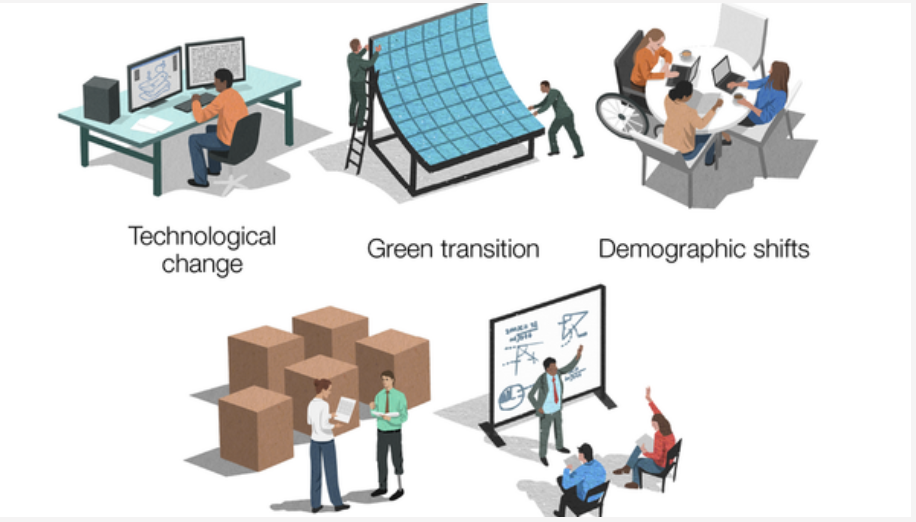
The World Economic Forum has published it's Future of Jobs Report. Hrpro.be was through its membership of the European Association for People Management (EAPM) a partner of this research. We have obtained a report for the Belgian Economy. But here you can find the general consluions of the global report. Broadening digital access is expected to be the most transformative trend – both across technology-related trends and overall – with 60% of employers expecting it to transform their business by 2030. Advancements in technologies, particularly AI and information processing (86%); robotics and automation (58%); and energy generation, storage and distribution (41%), are also expected to be transformative. These trends are expected to have a divergent effect on jobs, driving both the fastest-growing and fastest-declining roles, and fueling demand for technology-related skills, including AI and big data, networks and cybersecurity and technological literacy, which are anticipated to be the
9 April 2025

Telework 5 years after the Pandemic
5 years of teleworkingEmployer survey results January/February 2025 Introduction : At the beginning of 2025, the Vias institute and the Antwerp Management School Next Generation Work Center of Expertise conducted a study on teleworking among Belgian employers. The online survey was conducted between January 20 and February 17, 2025, among 759 employers, 25% of whom were business owners, 40% managers, and 35% human resources managers. The survey was conducted at the request of the FOD Mobiliteit en Vervoer / SPF Mobilité et Transports supported by VBO FEB , HRPro.be, SD Worx , Securex , De Tijd and HRmagazine . This survey is for hrpro.be one of many we supported, also during the pandemic. Teleworking today and tomorrow In 2025 , structural teleworking is the most represented among our respondents: in 86.1% of organizations employing more than 500 workers and in around 3/4 of smaller organizations. In the future , we also expect that the majority of organizations, regardless of their si
10 April 2025

EBHR - Episode 1 - Starting with Evidence-based HR
Text by Edward Van Houtte & Iulia Cioca Evidence-based HR (EBHR) is a way to make people decisions in organizations. It’s a day-to-day practice of using the best available evidence and looking at it with a critical eye, to inform HR decisions. By practicing EBHR, your decisions are more likely to achieve the results you expect from them. Questioning Your Evidence What about you and your last decision at work? Are you confident the process and the outcome were good? What if there’s a better way of making HR decisions that makes it more likely to actually get the results you expect? Let’s learn to expect the unexpected. You might be thinking: “So, what’s wrong with my decision-making methods? I’m pretty happy with how most of my decisions turn out.” You might be, but researchers have looked at how decisions are made in organizations, and their conclusions are not so optimistic, namely: decision-makers use whatever evidence they have at hand, without asking themselves where it comes from
9 April 2025

May 13 2025 - Event - Leading Change in a Dynamic World
HumanifyAI – Leading Change in a Dynamic World The world of work is evolving at an unprecedented pace, and as HR and people professionals, we are at the forefront of leading change together. This International HR Day, join us for an insightful webinar exploring two critical themes driving our profession forward: 🔹 Leading in a Digital World – How can we ensure ethical and transparent use of AI and other technology? How do we design digital transformation that enhances equality, autonomy, and job satisfaction while protecting employee wellbeing and organisational culture? 🔹 Skills and Learning for the Future – With change happening faster than ever, how do we invest in new skills, create sustainable people practices, and future-proof employees? From transitional skills to new learning methods, discover how HR can drive continuous development. Why Attend? Gain expert insights on navigating digital transformation in HR Explore strategies for ethical AI and digitalization in the workplac
9 April 2025
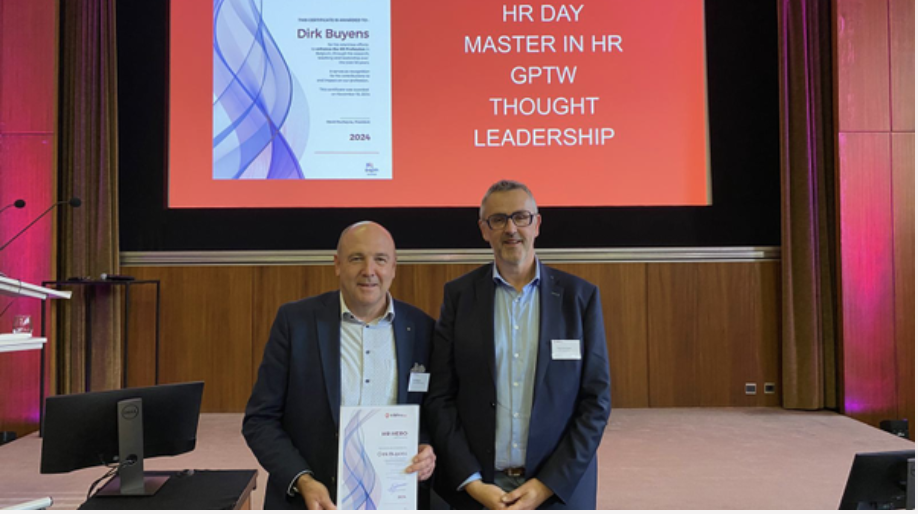
Professor Dirk Buyens receives the inaugural HeRo-Award
[Brussels, November 18, 2024] – The Belgian Association of HR Professionals, hrpro.be, proudly presented its first-ever HR Hero Award to Prof. Dirk Buyens during its annual national conference. This distinguished award celebrates individuals who have made outstanding contributions to the field of human resources, exemplifying leadership, innovation, and dedication to advancing HR practices. Each year, the HR Hero Award will honor an individual whose exceptional efforts in practice, teaching, research, or thought leadership have significantly advanced the growth and development of the HR profession. Rather than being the result of a competitive process, the award serves as a heartfelt recognition of the recipient’s enduring impact and their commitment to the values of the HR community. The recipient holds the lifetime title of HR Hero, a distinction that reflects their ongoing dedication to the core principles and integrity of the HR profession. This year, Prof. Dirk Buyens was celebrat
9 April 2025

EBHR - Episode 3 - A new Conceptualisation of EBHR
Researchers from Louvain and Groningen conducted an in-depth review on evidence-based HR practices, providing valuable insights into how HR professionals can strengthen their decision-making through evidence-based management. The study highlights three key areas of focus for HR leaders: Effective Methods for Evidence-Based Management Critical Skills for HR and Business Leaders Bridging the Gap Between Research and Practice Methods to use in an EBHR approach A wealth of high-quality evidence is available to support effective HR practices, including meta-analyses, systematic reviews, and controlled evaluations. To implement evidence-based management effectively, HR professionals should utilize rigorous methods such as: Systematic literature reviews Quasi-experimental designs Evidence-based problem-solving cycles Evidence-based management framework. By adopting these practices, HR can ensure that decision-making is driven by data, not intuition, and remains aligned with organizational obj
9 April 2025
